Nickel Free Stainless Steel: What Buyers and Brands Need to Know
Most stainless steel watches and jewelry are not literally nickel free by composition. High-quality 316L stainless steel contains roughly 10–14% nickel, yet its chromium oxide passive layer keeps nickel release so low that it qualifies as hypoallergenic stainless steel for the vast majority of wearers. For severe nickel allergies or fresh piercings, titanium or niobium are the genuinely nickel free alternatives.
Your immediate options at a glance:
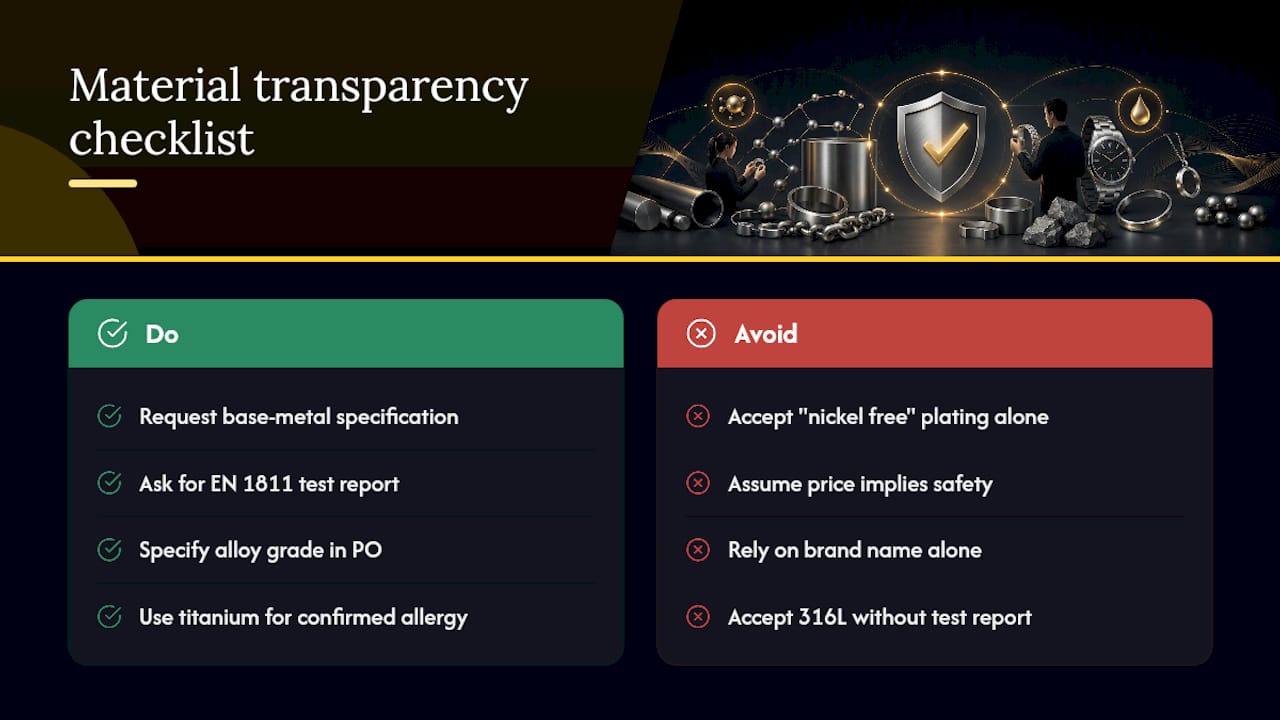
- Most wearers: Verified 316L with a mill certificate or EN 1811 nickel-release test report
- Sensitive skin: 316L with documented third-party lab testing (SGS, Intertek)
- Severe nickel allergy: Titanium, niobium, or medical-grade ceramics
- B2B buyers: Specify 316L grade in writing, request Material Test Reports (MTRs) and sample-wear approval before production
Pro Tip: “Surgical steel” and “hypoallergenic” mean nothing without documentation. Always ask for the grade and the test report.
Key Takeaways
Verified 316L stainless steel is the practical choice for most hypoallergenic watch and jewelry applications; titanium or niobium are the right call when a confirmed nickel allergy is involved.
| Point | Details |
|---|---|
| 316L is nickel-safe, not nickel-free | It contains 10–14% nickel but releases far below EU EN 1811 thresholds under normal wear. |
| Always request documentation | Ask for an MTR and EN 1811 test report; “hypoallergenic” labeling alone has no legal weight in the U.S. |
| Higher price does not mean safer | 904L contains more nickel than 316L, so luxury grade does not equal lower allergy risk. |
| Severe allergy needs a different material | A positive nickel patch test means switching to titanium, niobium, or ceramics, not just a better grade of steel. |
| Wynwoodblvd supports B2B documentation | Corporate buyers can request sample programs, MTRs, and custom branding through Wynwoodblvd’s B2B program. |
Table of Contents
- What should you ask before buying nickel free jewelry or a watch?
- What does “nickel free” actually mean for watches and jewelry?
- Which alloys are used in watch cases and jewelry, and what are the risks?
- How do you verify a piece is actually safe to wear?
- Corporate buyers: how to specify materials and manage custom orders
- How to care for your watches and jewelry to reduce nickel exposure
- When should you see a doctor about a metal allergy?
- Why material transparency matters more than marketing claims
- Wynwoodblvd custom watches and jewelry for hypoallergenic corporate gifts
- Sources
What should you ask before buying nickel free jewelry or a watch?
Use this checklist at the point of purchase or when issuing a request for quote (RFQ).
For consumers:
- Ask for the exact alloy grade (316L, 304, or other)
- Request a mill certificate or MTR confirming composition
- Ask whether the piece is solid metal or plated, and what the base alloy is
- Confirm whether any EN 1811 or third-party nickel-release test has been done
- Check for visible stamps: “316L,” “surgical steel,” or a hallmark
For corporate buyers:
- Include alloy grade and nickel-release threshold in your written spec
- Request MTRs and XRF spot-test results for pre-production samples
- Ask for a sample-wear protocol before batch sign-off
- Confirm MOQ, lead time, and rework policy for plating failures
- Get warranty and return terms in writing
Pro Tip: A seller who only says “hypoallergenic” or “nickel free” without any documentation is describing marketing language, not a tested material. The U.S. has no federal legal definition for “nickel free” labeling, so documentation is your only real protection.
What does “nickel free” actually mean for watches and jewelry?
The phrase “nickel free” is used inconsistently across the jewelry and watch industry. Understanding the difference between nickel content and nickel release is the most practical thing you can learn before buying.
Nickel content vs. nickel release
An alloy can contain nickel and still be safe for skin contact, because what triggers contact dermatitis is the amount of nickel that migrates out of the metal and onto your skin, not the total percentage in the alloy. The EU Nickel Directive (enforced through EN 1811 testing) sets release limits at 0.2 μg/cm²/week for items that penetrate the skin (piercings) and 0.5 μg/cm²/week for other jewelry. 316L stainless steel’s passive chromium oxide layer keeps release well below those thresholds under normal wear conditions.
Key insight: A piece labeled “nickel free” in the U.S. may only mean the plating is nickel free, while the base alloy still contains nickel. Once plating wears through, nickel release can rise sharply. Solid 316L with a verified low-release test is a more reliable choice than a plated piece with no base-metal disclosure.
The U.S. currently has no federal equivalent to the EU Nickel Directive, so American buyers cannot rely on labeling alone. Requesting an EN 1811-style test report or an SGS/Intertek certificate is the practical workaround.
Which alloys are used in watch cases and jewelry, and what are the risks?
Common materials span a wide range of nickel content and allergy risk. Higher nickel percentage does not automatically mean higher release, but it does raise the ceiling if corrosion resistance is poor or the finish degrades.
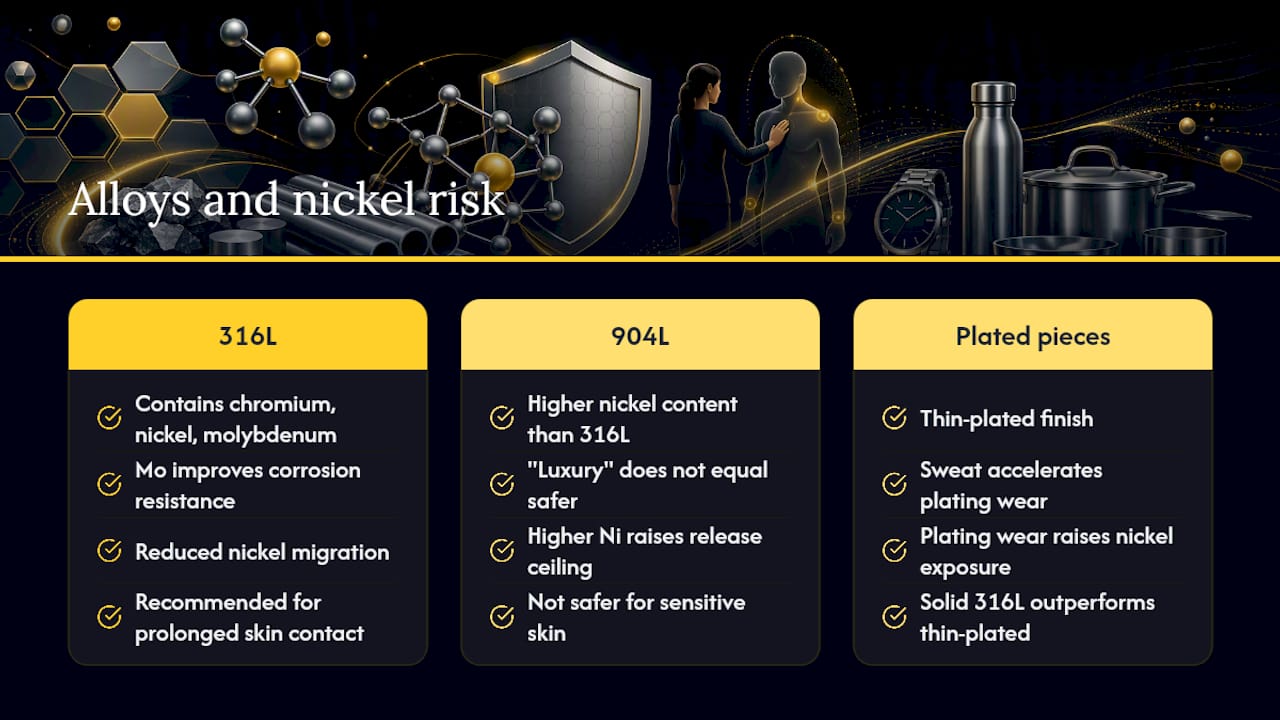
316L contains chromium, nickel, and molybdenum, with the molybdenum specifically improving corrosion resistance and reducing nickel migration. That is why it is the standard recommendation for jewelry and watch cases intended for prolonged skin contact.
One point worth knowing: nickel sensitivity affects an estimated 10–20% of the general population, making it one of the most common contact allergens. A higher-priced alloy is not a substitute for verified low release. 904L, used in some premium watch lines, carries a higher nickel content than 316L — more than 316L — so “luxury” does not equal “safer for sensitive skin.”
Pro Tip: For water-resistant jewelry or watches worn during exercise, solid 316L outperforms thin-plated pieces because sweat accelerates plating wear and raises nickel exposure risk.
How do you verify a piece is actually safe to wear?
Verification comes in layers. Start with documents, then confirm with physical checks.
Accepted documents to request:
- Mill Test Report (MTR) confirming alloy grade and composition
- EN 1811 nickel-release test report (SGS, Intertek, or equivalent accredited lab)
- XRF (X-ray fluorescence) spot-test results for finished pieces
- ISO or ASTM material compliance certificates where available
Practical on-site checks:
- Look for stamps: “316L,” “surgical steel,” or a recognized hallmark
- Ask whether the piece is solid or plated, and request the base-metal spec
- Request a sample-wear test (wear for 2–4 weeks, inspect for skin reaction or finish degradation)
Steps for procurement teams (RFQ checklist):
- Include alloy grade (316L minimum) and nickel-release threshold in the written spec
- Request MTRs for each material batch
- Order pre-production samples and run an independent XRF check
- Submit samples to an accredited lab for EN 1811 nickel-release testing
- Conduct a sample-wear protocol before approving full production
- Retain one signed sample per batch for reference
Reputable suppliers will share MTRs and lab reports without hesitation. A supplier who resists sharing documentation is a risk signal.
Pro Tip: Retain a signed physical sample from each approved batch. If a quality dispute arises later, that sample is your reference point for independent re-testing.
Corporate buyers: how to specify materials and manage custom orders
For businesses ordering branded watches or bulk jewelry, material specification is a procurement decision, not just a product preference.
Recommended material specs:
- Primary choice: 316L stainless steel with MTR and EN 1811 test report for each batch
- Truly nickel free option: Titanium (Grade 2 or 5) or niobium for clients with documented nickel sensitivity policies
- Finish: PVD coating over 316L for color options; confirm coating thickness and adhesion data
Pricing factors to plan for:
- Material cost (titanium runs higher than 316L)
- PVD finishing and color customization
- Logo engraving or dial customization
- Third-party testing and certification fees
- MOQ requirements (typically higher for custom finishes)
- Rework cost if plating fails QC
Sample and approval timeline:
- Submit written spec with alloy grade, finish, and branding requirements
- Receive prototype samples (typically 2–4 weeks)
- Run wear test and independent lab check on samples
- Approve or revise; confirm batch MTRs
- Place production order with signed sample retained
Specifying 316L with independent EN 1811 test reports and a sample-wear protocol before full production sign-off is the lowest long-term risk approach for corporate buyers. Wynwoodblvd supports this process with sample programs and documentation for B2B clients.
Pro Tip: Label your branded pieces as “hypoallergenic” or “nickel-safe” rather than “nickel free” to avoid legal ambiguity in the U.S. market, where “nickel free” has no regulated definition.
How to care for your watches and jewelry to reduce nickel exposure
Good care habits extend finish life and keep nickel release low over time.
Daily habits:
- Wipe pieces with a soft, dry cloth after wear, especially after sweating
- Remove watches and jewelry before swimming in chlorinated pools for extended periods
- Avoid contact with bleach, strong detergents, and acetone-based products
- Store pieces separately to prevent scratching the passive layer
Maintenance schedule:
- Inspect plated pieces every 3–6 months for chips, peeling, or discoloration
- Re-PVD or re-plate when the coating shows visible wear
- Polish solid 316L pieces with a non-abrasive cloth to maintain the passive layer
Plating can conceal a base alloy that contains nickel. Once plating wears through, nickel release can increase significantly. Solid 316L pieces carry less long-term risk than thin-plated fashion pieces for anyone with sensitive skin.
Pro Tip: Avoid ultrasonic cleaners on plated pieces — they can accelerate coating separation and expose the base metal faster than normal wear.
When should you see a doctor about a metal allergy?
See a dermatologist if you experience persistent redness, itching, or blistering at the contact point of a watch or piece of jewelry, especially if the reaction spreads or recurs with multiple metals.
Signs that warrant a medical appointment:
- Skin reaction that does not clear within a few days of removing the piece
- Reaction to items labeled “hypoallergenic” or “surgical steel”
- Widespread dermatitis not limited to the contact area
- History of reactions to multiple metals
What patch testing involves:
A dermatologist applies small amounts of common allergens, including nickel, to your skin under adhesive patches for 48 hours. Results are read at 48 and 96 hours. A positive nickel patch test means your immune system reacts to nickel contact, and you should switch to genuinely nickel free materials: titanium, niobium, or medical-grade ceramics.
This article provides general information only and is not a substitute for medical advice. Consult a dermatologist for diagnosis and treatment of suspected metal allergies.
Before your appointment:
- Note which pieces caused reactions and for how long you wore them
- Bring the alloy grade or product spec if available
- List any other metals, cosmetics, or products that have caused reactions
Why material transparency matters more than marketing claims
Most buyers assume that a higher price or a premium brand name guarantees a safer material for sensitive skin. The data does not support that assumption. 904L, used in some well-known luxury watches, contains roughly twice the nickel percentage of 316L. The passive layer and corrosion resistance of the alloy matter far more than its price point or marketing positioning.
The other gap I see consistently: sellers who use “nickel free” as a label for the plating while the base alloy is undisclosed. In the U.S., that labeling is technically legal because there is no federal standard defining the term. For consumers, that means the only reliable protection is asking for the base-metal spec and a test report. For corporate buyers, it means putting alloy grade and nickel-release thresholds in the written purchase order, not just in a conversation.
316L with documented EN 1811 testing is the practical sweet spot for most watch and jewelry applications. It is durable, cost-effective, and safe for the vast majority of wearers. Titanium is the right call when a client has a confirmed allergy or a zero-tolerance policy. Ceramics and plastics work for specific design applications but cannot replicate the finish range of stainless steel.
The brands and buyers who get this right are the ones who treat material documentation as a standard part of the order process, not an afterthought.
Wynwoodblvd custom watches and jewelry for hypoallergenic corporate gifts
Wynwoodblvd builds premium 316L stainless steel watches and jewelry for both individual buyers and corporate clients who need branded merchandise that holds up to scrutiny on material safety.
Every piece uses 316L stainless steel as the base material. For B2B orders, Wynwoodblvd provides sample approval programs, material documentation, and custom branding options including logo engraving, dial customization, and packaging. The Atlantic Blue Automatic Watch is a strong example of the brand’s 316L construction and PVD finish quality. Corporate clients can also browse the full Miami-inspired watch collection or request a custom quote through the B2B program page. Post-order quality checks and a documented returns policy are included for all corporate orders. Contact Wynwoodblvd directly to request samples, MTRs, and a project quote.
Sources
The following sources informed the guidance in this article. Procurement teams can use these links to review the underlying data directly.
- Is Stainless Steel Jewelry Safe to Wear? - ScienceInsights
- SAE 904L stainless steel - Wikipedia
- What Is 316L Stainless Steel and Is It Safe for Jewelry? - Jiman Jewelry
- Is Stainless Steel Jewelry Hypoallergenic? The Complete Guide for Sensitive Skin (2026)