Custom Jewelry Packaging: A Wholesale Guide for Small Brands
Start with the structure that fits your best-selling SKU. Before you pick a finish, a foil color, or a supplier, decide whether your hero product is a ring, a pair of earrings, or a pendant necklace. That single choice locks in your box dimensions, insert type, and shipping footprint, which means every proof and sample you request will actually be meaningful.
- Pick your core SKU first. A ring box, earring card, or small rigid gift box built around your actual product dimensions prevents costly resizing after tooling.
- Reduce risk with a staged approach. Start with a stock or semi-custom style and add one branded element (printed tissue, a sticker, or a thank-you card) before committing to full custom tooling. Per-unit costs for a branded stack like this typically sit in the $0.50–$1.50 range for most small jewelry SKUs.
- Test before you scale. Low-MOQ options (as few as 100 units for some stocked styles) let you validate the look and fit before ordering 1,000+ units of a fully custom box.
Key Takeaways
Custom packaging for jewelry succeeds when you lock in one core structure for your hero SKU first, then layer branding and finishes only after a physical sample confirms the fit.
| Point | Details |
|---|---|
| Start with structure | Pick the box style that fits your best-selling SKU before choosing any finish or branding method. |
| Stage your investment | Combine a stock box with branded tissue, a sticker, or a card to test the market before full custom tooling. |
| Require a physical sample | Always test insert fit with your actual piece before approving mass production. |
| Verify eco claims | Request FSC or GRS certificate numbers and material data sheets, not just logos, from any supplier. |
| Wynwoodblvd B2B | Custom-branded packaging is available alongside watches and jewelry for corporate and bulk orders. |
Table of Contents
- What to decide before requesting a quote for custom packaging for jewelry
- Box styles matched to jewelry types and retail channels
- Materials and finishes: how to match perceived value, protection, and sustainability
- Inserts, padding, and anti-tarnish protection
- Branding and printing methods: picking the right logo treatment
- MOQs, pricing tiers, and realistic production timelines
- How to order: dielines, artwork specs, and quality checks
- Supplier selection: questions to ask and red flags to watch for
- Eco-friendly packaging options: trade-offs and what to request from suppliers
- Wynwoodblvd’s custom packaging and B2B ordering
- Sources
What to decide before requesting a quote for custom packaging for jewelry
Walk into a supplier conversation with these answers ready and you will cut quote turnaround in half.
- SKU dimensions and weight: measure your actual piece, including the widest point of a pendant or the diameter of a ring at its widest band.
- Primary sales channel: online DTC shipping, retail display, or corporate gifting each demands different structural strength and presentation priorities.
- Target per-unit price: set a ceiling before you see options, or finish choices will creep the budget upward fast.
- Protection level: a display-only box for a boutique shelf needs far less structural rigidity than a box that ships unprotected through a carrier network.
- Preferred material: pick one to anchor the conversation (kraft, rigid board, or molded pulp) and treat others as upgrades to evaluate.
- Branding finishes to test: limit yourself to one or two (matte lamination plus a foil stamp, for example) so proofs stay focused.
- Target MOQ: know whether you need 100 units or 1,000 before you open a catalog.
- Lead time requirement: factor in proof rounds, a physical sample, and production time before your launch date.
- Sustainability requirements: if FSC or GRS certification is non-negotiable for your brand story, say so upfront — it narrows the supplier list immediately.
Box styles matched to jewelry types and retail channels
The right structure depends on the piece, the price point, and where the customer opens it.
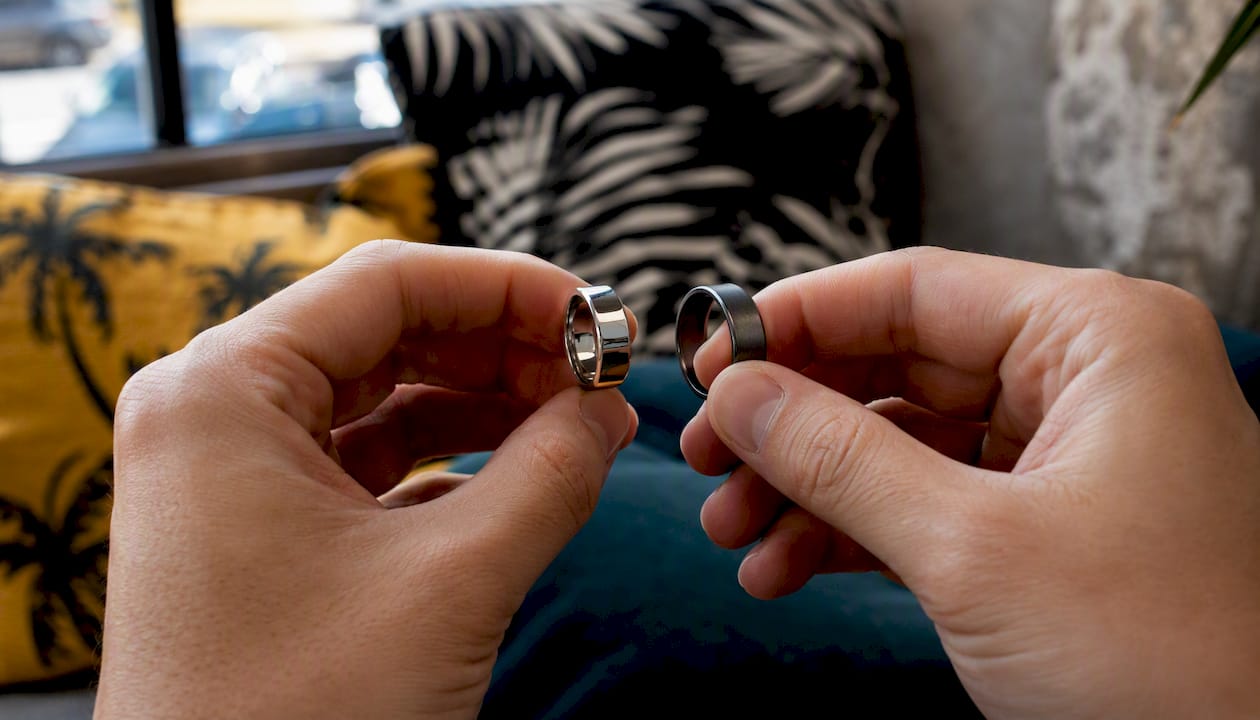
- Ring boxes are the most recognizable format: a hinged clamshell or a lid-and-base rigid box with a velvet-wrapped foam insert. They photograph well and hold their shape through shipping. See how Wynwoodblvd’s ring collection approaches sizing if you need a real-world SKU reference.
- Earring cards and small folding cartons work for lightweight studs and hoops. They are low-cost, easy to display on a rack, and ideal for markets, pop-ups, and event gifting.
- Magnetic-closure and hinged clamshells signal a higher price point. The satisfying snap of a magnetic lid alone shifts perceived value upward, which matters for pieces priced above $80–$100.
- Padded pouches and drawstring bags (velvet or suede) serve daily-use storage and travel. They are not a primary retail pack on their own, but they add perceived value as a secondary layer inside a rigid box.
- Drawer-style boxes and sleeve-plus-box systems suit gift sets and wholesale presentation. A sleeve printed with your brand wraps a plain rigid box, keeping tooling costs low while delivering a premium look.
- Pendant and necklace packaging needs extra vertical depth or a channel insert to route the chain without kinking. Check your chain length against the box interior before ordering samples. The necklace collection at Wynwoodblvd illustrates the range of pendant lengths that drive those dimension decisions.
Pick one core style per SKU family. Mixing three box formats across a small catalog multiplies your inventory complexity and kills reorder efficiency.
Materials and finishes: how to match perceived value, protection, and sustainability
Material choice is where budget, brand positioning, and sustainability goals collide. Premium jewelry packaging typically uses rigid board, textured papers, velvet linings, and leatherette, with printing options spanning CMYK, PMS spot color, and foil stamping.
- Rigid board (greyboard or chipboard core): the standard for premium boxes. Heavy, structured, and compatible with nearly every finish. Higher per-unit cost, but it communicates quality the moment a customer lifts the lid.
- Paperboard (10pt–28pt stock): lighter and less expensive than rigid board. Works well for folding cartons, earring cards, and sleeve wraps. Thinner stocks (10pt–16pt) suit cards and inserts; heavier stocks (24pt–28pt) handle small folding gift boxes.
- Molded pulp: 100% biodegradable and ships nested, which cuts freight weight. It accepts debossing and can be sleeved for branding. The trade-off is that molded pulp MOQs tend to run higher — one supplier lists 5,000 units for certain styles — and high-shine finishes are not compatible with the texture.
- Kraft: honest, low-cost, and on-trend for handmade or nature-inspired brands. It pairs well with soy-ink printing and twine closures but limits color accuracy for complex logos.
- Velvet and suede lining: used as interior lining rather than a structural material. Velvet-wrapped foam inserts add tactile richness and protect stones and metal surfaces from scratching.
Finishes to know:
- Matte/soft-touch lamination: the most popular premium finish right now. Fingerprint-resistant and tactile.
- Gloss lamination: lower cost, higher shine, less premium feel.
- Spot UV: a clear gloss layer applied to a specific area (your logo, for example) over a matte base. High contrast, low tooling cost.
- Foil stamping (metallic or holographic): requires a metal die. Gold and silver foil read as luxury. Die cost is a one-time setup fee, usually refunded or credited on reorder.
- Emboss/deboss: raises or recesses your logo into the material. Works best on thicker stocks and rigid board. Requires a separate tool.
- Hot stamp: similar to foil but applied with heat and pressure directly to the substrate. Common for logo marks on velvet pouches and rigid boxes.
Pro Tip: Matte lamination plus a single foil-stamp logo is the most cost-effective premium combination for small brands. It requires only one die, photographs well, and keeps the finish count low enough to stay within a tight MOQ.
Inserts, padding, and anti-tarnish protection
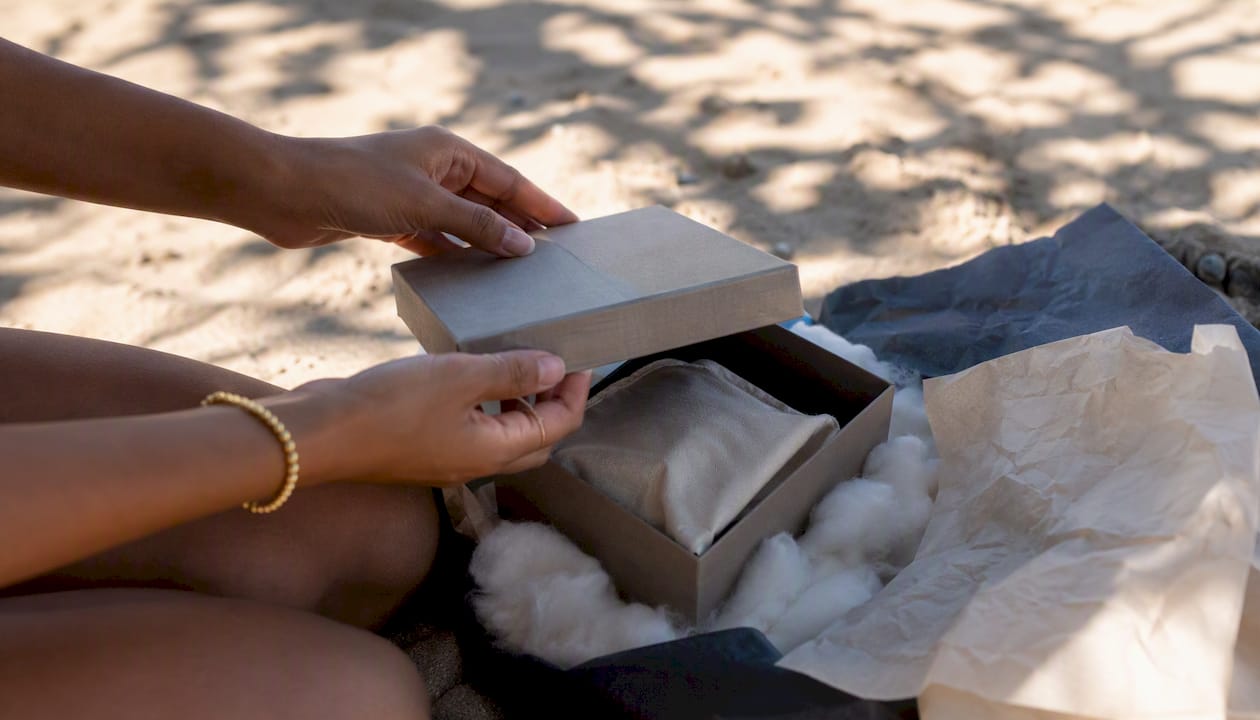
An insert that fits poorly is worse than no insert at all. A ring that rattles, a chain that kinks, or a pendant that scratches against a foam edge will generate returns and damage reviews.
- Foam/EVA inserts: the most common option. Soft, compressible, and available in pre-cut ring slots or custom-cut shapes. Density matters: too soft and the piece sinks; too firm and removal is awkward.
- Shaped paperboard inserts: lower cost than foam, recyclable, and surprisingly effective for earring cards and flat pendants. Not ideal for heavy rings or pieces with protruding stones.
- Molded pulp/paperboard inserts: custom-shaped to the piece. Biodegradable and structurally precise, but tooling adds cost and lead time.
- Velvet-wrapped cores: a foam core wrapped in velvet fabric. The standard for ring boxes and clamshells at the mid-to-premium tier. Protects metal surfaces and photographs beautifully.
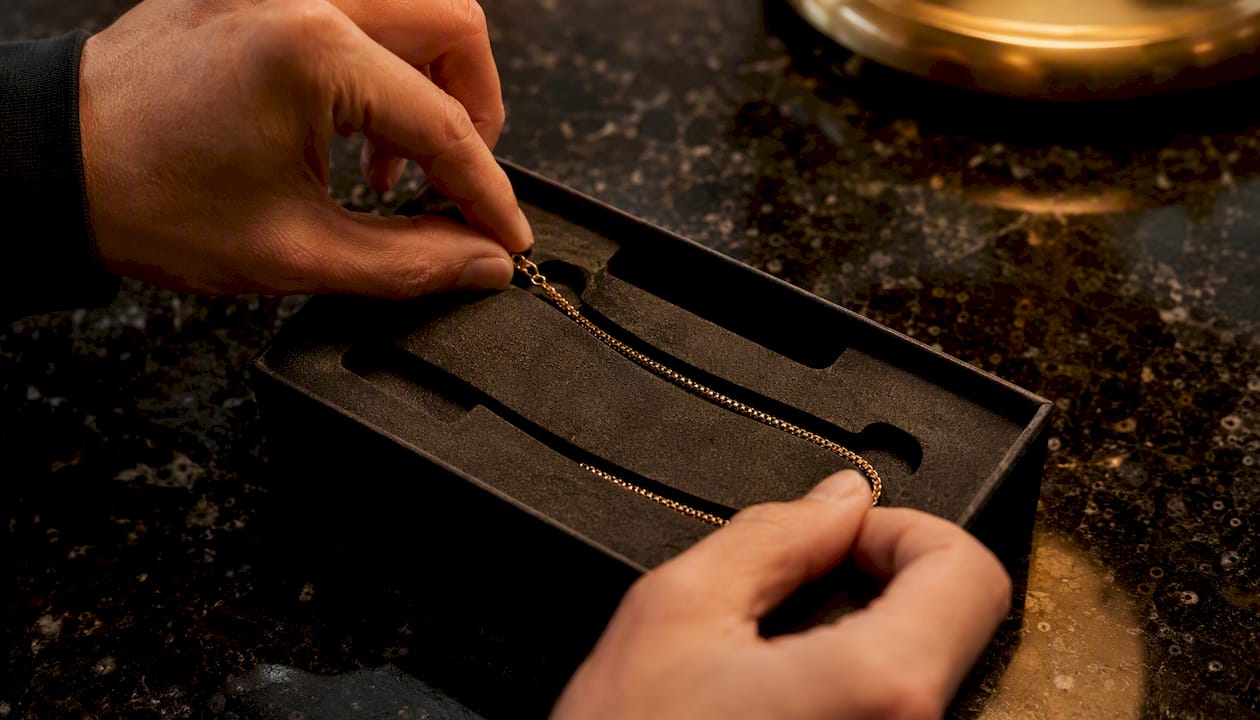
- Custom-cut chain channels: for necklaces and bracelets, a routed channel in foam or a paperboard card with a hook slot keeps chains flat and tangle-free.
Anti-tarnish protection matters most for sterling silver. Anti-tarnish bags (3M Intercept or similar), anti-tarnish paper liners, and coated interior surfaces all slow oxidation. If you sell silver pieces, include at least an anti-tarnish bag inside the box. For customers with sensitive skin, the material choices inside the box matter as much as the jewelry itself — the hypoallergenic jewelry guide covers lining and material safety in more detail.
Pro Tip: *When you receive a physical sample, test insert removal with the actual SKU in your hand, not a substitute piece. Check that stones don’t catch on foam edges and that chains pull free without snagging.
Branding and printing methods: picking the right logo treatment
The method you choose affects MOQ, tooling cost, color accuracy, and how the finished box reads at arm’s length.
- Digital/full-color (CMYK): no plates, no dies, low setup cost. Best for photographic artwork, complex gradients, and short runs. Color consistency can vary slightly between batches.
- Offset printing (CMYK or PMS): higher setup cost but precise, consistent color across large runs. Worth it above roughly 1,000 units.
- PMS spot color: a single mixed ink matched to a Pantone reference. Accurate, repeatable, and essential when your brand color is specific (a particular navy or coral, for example).
- Foil stamping (metallic): requires a metal die. Gold, silver, rose gold, and holographic foils are common. Die cost is a one-time fee; reorders use the same die.
- Hot stamp: heat-applied foil or pigment directly to the substrate. Common on velvet pouches and rigid box lids. Lower die cost than full foil stamping for simple marks.
- Emboss/deboss: a tactile logo impression. Requires a separate tool from a foil die. Often combined with foil for a foil-emboss effect.
- Printed sleeves: a full-color sleeve wraps a plain rigid box. No tooling for the box itself; all branding lives on the sleeve. Low MOQ, easy to update seasonally.
| Method | MOQ-Friendly? | Tooling/Setup Cost | Best For |
|---|---|---|---|
| Digital CMYK | Yes (100+ units) | None | Short runs, complex artwork |
| PMS offset | No (1,000+ units) | Plate fee | Precise brand color at volume |
| Foil stamp | Moderate (500+) | Die fee (one-time) | Logo marks, luxury tier |
| Hot stamp | Moderate | Die fee (lower) | Pouches, rigid box lids |
| Emboss/deboss | Moderate (500+) | Tool fee (one-time) | Tactile logo on rigid board |
| Printed sleeve | Yes (100+) | None | Seasonal updates, low MOQ |
Logo complexity directly affects cost. A clean, single-color wordmark or icon stamps and embosses cleanly. A detailed illustration with thin lines and tight curves loses definition in foil and deboss — simplify the artwork before sending to a supplier, or request a press proof on the actual substrate before approving.
MOQs, pricing tiers, and realistic production timelines
Expectations set early prevent expensive surprises later.
MOQ ranges by customization level:
- Stock boxes with branded print (sticker, tissue, card): 100–500 units. Lowest risk, fastest turnaround.
- Semi-custom (stock structure, custom print): 100–1,000 units. Some suppliers offer US-stock expedited options at MOQ 100 for selected premium styles with 5–7 day delivery.
- Fully custom rigid boxes (custom structure + custom print): 500–5,000+ units. Tooling fees apply; lead times are longer.
Cost drivers to budget for:
- Material grade and wall thickness
- Box size and volume (larger boxes cost more to ship)
- Number of print finishes (each adds setup cost)
- Insert complexity and material
- Color matching (PMS vs. CMYK)
- Tooling plates and dies (foil, emboss, custom dielines)
- Freight and dimensional weight charges
| Production stage | Typical calendar time |
|---|---|
| Quote to artwork approval | 3–7 days |
| Digital proof | 1–3 days |
| Physical sample | 7–12 days |
| Pre-production approval | 2–5 days |
| Mass production | 10–12 days |
| Shipping (sea freight) | 20– |
| Shipping (air freight) | 5–10 days |
Some suppliers list custom process turnarounds of 10–12 business days for certain finishing steps, with rush options available. Build at least one buffer week into every milestone when planning a product launch.
How to order: dielines, artwork specs, and quality checks
A clean file package sent on day one prevents two weeks of back-and-forth.
Artwork files your supplier needs:
- Vector logo file (AI, EPS, or PDF with outlined fonts)
- CMYK and/or PMS color references for every brand color
- Dieline template (the supplier provides this; you place artwork on it)
- Bleed area marked (typically 3mm beyond the cut line)
- Safe area respected (keep text and logos at least 3mm inside the cut line)
- Separate layers for foil, emboss, and print elements
- Emboss/foil clearance noted (minimum 2mm between foil and edge)
Request these items in this order before approving mass production:
- Digital mock-up (3D render or flat dieline with artwork placed)
- Flat dieline proof (printed on actual substrate, unassembled)
- Physical assembled sample with your actual SKU inside
- Pre-production color-match sample from the production run
- Signed approval document before the mass run begins
Quality checks to run on every physical sample:
- Color accuracy against your PMS reference under natural light
- Insert fit with the actual piece (not a substitute)
- Jewelry removal ease — test with one hand, as a customer would
- Odor check on linings and inks (some coatings off-gas; it fades, but it matters at unboxing)
- Packed transit test: ship one sample to yourself via your standard carrier before approving mass production
Suppliers with full OEM/ODM capabilities can support prototyping and private molds for truly bespoke shapes, which is worth exploring once your volume justifies the tooling investment.
Supplier selection: questions to ask and red flags to watch for
The supplier you choose matters as much as the design you approve.
Questions to ask every shortlisted supplier:
- What is your MOQ for this specific style and finish combination?
- What is your sample lead time, and is there a sample fee?
- Which finishes do you produce in-house versus outsource?
- Can you provide FSC or GRS certification documentation?
- What is your standard production lead time after sample approval?
- Do you refund or credit tooling fees on reorder?
Trust signals worth paying attention to:
- Published MOQ and pricing tiers (not “contact us for pricing” on every line)
- A clear sample process with photos of previous work
- Factory audit reports or third-party QC documentation
- References from brands in a similar category and price tier
- A dieline library or template download available before you commit
Red flags:
- Vague or evasive answers about tooling fees
- No physical sample option (digital mock-up only)
- Missing dielines or no proofing process described
- Lead-time estimates that shift without explanation between messages
- Pressure to approve artwork before a physical sample is confirmed
Pro Tip: Ask for photos of the actual production facility or a video of your sample being assembled. Suppliers who can provide this quickly are almost always more reliable than those who deflect the request.
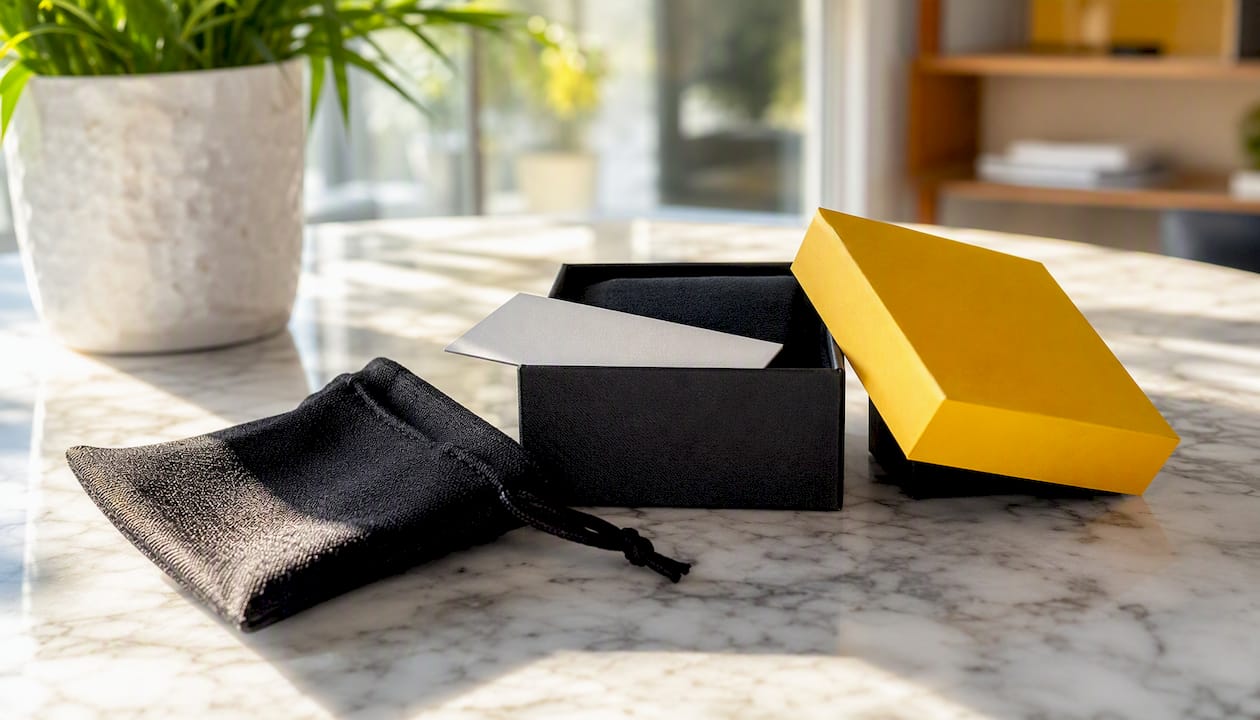
For a small necklace gift set or a ring presentation, the packaging format you choose signals the brand tier before the customer even opens the box — supplier reliability is what keeps that signal consistent across every order.
Eco-friendly packaging options: trade-offs and what to request from suppliers
Sustainability is now a baseline expectation for many jewelry buyers, not a differentiator. The question is which eco option fits your production reality.
- Recycled paperboard (FSC-certified): the most practical starting point. EcoEnclose publishes spec tables showing recycled content percentages, thickness, and print options (including HydroSoy inks) — request the same data from any supplier you evaluate.
- Molded pulp: biodegradable, ships nested, and reduces freight weight. Accepts debossing and sleeve branding. The operational trade-off is real: higher MOQs (some suppliers list 5,000 units) and limited compatibility with high-shine finishes.
- rPET fabrics: recycled polyester for pouches and bag linings. Carries a GRS (Global Recycled Standard) certification path. Durable and soft, but not biodegradable.
- Soy-based inks: lower VOC than petroleum inks, compatible with most paperboard stocks, and increasingly standard among FSC-certified suppliers.
- Plastic-free closures: replace ribbon pulls and magnetic closures with paper-based or natural-fiber alternatives. Small change, meaningful for brands targeting zero-plastic messaging.
Operational trade-offs to plan for:
- Some eco materials push MOQ higher or require longer lead times due to smaller supplier networks.
- Molded pulp limits your finish options: matte and deboss work; gloss lamination and metallic foil do not.
- FSC-certified board costs slightly more per unit but is widely available at MOQs of 100–500.
What to request from suppliers in writing:
- FSC or GRS certificate number (verify it on the issuing body’s database)
- Material data sheet showing recycled content percentage and post-consumer waste content
- Ink specification (soy-based, water-based, or UV-cured)
- Recycling or composting instructions you can pass on to customers
- Photos of finished parts showing material texture and print quality
Pro Tip: Request the FSC certificate number, not just the logo. You can verify it directly on the FSC database at info.fsc.org. A supplier who hesitates to provide the number is one to remove from your shortlist.
Why packaging is the last thing brands budget for and the first thing customers notice
Most small jewelry brands spend months on the piece itself and two days on the box. That order of operations is understandable, but it costs more in the long run. A ring that ships in a generic white box with a printed sticker is not a bad product. It is a missed moment. The customer photographs the unboxing, or they don’t. They keep the box, or they throw it away. They tell someone about the brand, or they don’t. Packaging is where that decision gets made.
What I have seen work, across brands that take product presentation seriously, is the staged approach: one core structure, one or two branded elements, and a physical sample tested with the actual SKU before any mass run. It sounds obvious. Most brands skip at least one of those steps and pay for it in returns, reorders, or a packaging refresh six months later.
Wynwoodblvd’s own experience with custom-branded corporate products reinforces this. The brands that get the most out of co-branded packaging are the ones who arrive with a clear SKU, a defined finish direction, and a realistic MOQ in mind. The ones who arrive with a mood board and no dimensions spend twice as long in the proof stage.
Wynwoodblvd’s custom packaging and B2B ordering
Wynwoodblvd builds premium branded products for companies, hotels, agencies, and lifestyle brands — and packaging is part of that conversation. When you order custom-branded watches or jewelry through the B2B program, packaging customization is available alongside the product itself, so your corporate gift or merchandise order arrives as a complete, presentation-ready set.
The Atlantic Blue automatic watch is one example of a product that ships as a full branded gift experience for corporate clients. Use the checklist from the second section of this article when you reach out — it will speed up the quote process and help the team match the right packaging format to your order volume and timeline. Contact Wynwoodblvd directly through the B2B page to request a quote or discuss sample runs.
Sources
- Which types of packaging are best for jewelry retailers?
- Eco Friendly Molded Pulp Jewelry Packaging Box — BonitoPak
- Jewelry packaging ideas for small businesses — Branvas