Stainless Steel vs Titanium Jewelry: Which One To Buy
If your skin reacts to nickel or you want the lightest possible feel for daily wear, titanium is the better choice. If you want a brighter mirror shine, more color and plating options, and a lower price, 316L stainless steel wins. That single trade-off, weight and hypoallergenic safety against polish and value, drives almost every decision in this comparison.
Here’s a fast breakdown by what you’re actually buying:
- Rings you’ll wear daily or that touch water constantly: stainless steel for value and shine, titanium if you have any nickel sensitivity.
- Watches and heavier pieces: stainless steel’s weight often reads as quality, and it takes plating and polishing better over years of wear.
- Body jewelry and fresh piercings: titanium, without much debate, because it heals better against irritated skin.
- Plated fashion pieces (gold, black, rose tones): stainless steel, since it holds PVD coatings more predictably than anodized titanium.
Keep reading for the grade-level details, a side-by-side comparison table, and a buying checklist that will save you from vague “surgical grade” marketing claims.
Key Takeaways
The material that fits you best depends on whether your priority is skin safety and light weight (titanium) or polish, color variety, and price (316L stainless steel).
| Point | Details |
|---|---|
| Check the grade, not the label | Look for “316L” or “Grade 2/5 titanium” on the listing; ignore vague terms like “titanium steel.” |
| Titanium wins on weight and allergy safety | About 40 to 45% lighter than steel and essentially nickel-free, best for sensitive skin and active wear. |
| Stainless steel wins on finish and value | Takes mirror polish and PVD plating better, at a noticeably lower price point. |
| Resizing favors steel | Titanium’s hardness makes resizing difficult or impossible; steel offers more repair flexibility. |
| Wynwood Blvd focuses on 316L | Our watches and jewelry use premium stainless steel for polish, color, and water resistance suited to coastal wear. |
Table of Contents
- Stainless Steel vs Titanium Jewelry: Grades That Actually Matter
- Comparing Jewelry Metals Side by Side
- Why Titanium Feels So Much Lighter On Your Hand
- Which Metal Holds Up Better Over Years Of Wear
- Sweat, Salt Water, And Everyday Moisture: What Actually Happens
- Best Jewelry For Sensitivity: Nickel And Allergy Risk
- Color And Plating: PVD, Anodizing, And What Lasts
- What You’ll Actually Pay, And When It’s Worth It
- How To Choose: A Buying Checklist That Actually Protects You
- Keeping Your Jewelry Looking New
- How Wynwood Blvd Thinks About Metal Choice
- Shop Wynwood Blvd’s Premium Stainless-Steel Collection
- Sources
Stainless Steel vs Titanium Jewelry: Grades That Actually Matter
Most sellers throw around terms like “surgical steel” or “titanium steel” without telling you the actual alloy grade, and that vagueness is exactly what you should watch for. The grade number tells you almost everything about durability, allergy risk, and price. The marketing label tells you almost nothing.
316L stainless steel (sometimes stamped S31603) is the grade you want to see on any piece marketed as hypoallergenic-friendly steel. The “L” means low carbon, which resists corrosion better at welds and edges. Sellers call it “surgical” or “marine grade” because the same alloy shows up in scalpels and boat fittings, and it relies on a self-healing chromium oxide layer to fight rust. Grade definitions from SageStone confirm 316L is the standard for quality steel jewelry, not just a nice-sounding label.
Titanium in jewelry usually means one of two grades. Grade 2 is commercially pure titanium, roughly 99% titanium with trace elements, and it’s what you’ll find in most affordable titanium rings and bands. Grade 5, also called Ti-6Al-4V, mixes in aluminum and vanadium for significantly higher strength, and it’s the grade referenced when a listing says “aerospace grade” or “implant grade” (tied to the ASTM F-136 standard used in medical implants). Grade 5 costs more to source and machine, which shows up directly in retail price.
“Titanium steel” is a marketing phrase, not a real alloy category, and it usually just means gold-toned or PVD-coated stainless steel, not titanium at all. If a listing uses that phrase without naming an actual grade, treat it as a caution flag rather than a spec.
Before you buy, check the product page for three things:
- A specific grade number (316L, Grade 2, Grade 5), not just “surgical” or “premium.”
- Whether “titanium steel” actually means plated stainless steel underneath.
- Any certificate or lab language that names a testing standard rather than a vague claim of purity.
| Material | Common Name | Typical Composition | Nickel Present |
|---|---|---|---|
| 316L Stainless Steel | Surgical/marine grade | Iron, chromium, nickel, molybdenum | Yes (bound in alloy) |
| Grade 2 Titanium | Commercially pure titanium | ~99% titanium, trace iron/oxygen | No |
| Grade 5 Titanium | Ti-6Al-4V, aerospace/implant grade | Titanium, 6% aluminum, 4% vanadium | No |
Comparing Jewelry Metals Side by Side
The table below lines up the dimensions that actually change your buying decision: comfort, safety, durability, and cost. “PVD” refers to physical vapor deposition, a plating process that bonds a thin metal coating to the surface. “Anodized” describes a color created by altering titanium’s natural oxide layer rather than adding a coating.
| Dimension | 316L Stainless Steel | Titanium (Grade 2/5) |
|---|---|---|
| Weight/comfort | Heavier, substantial feel | Notably lighter, better for all-day wear |
| Hypoallergenic/nickel | Contains nickel, low release | Essentially nickel-free |
| Durability/scratch resistance | Good, more prone to fine scratches | Grade 5 is harder and more scratch-resistant |
| Corrosion/water resistance | Strong, rinse after salt/chlorine | Excellent, better against long-term chloride exposure |
| Finish/color/plating | Mirror polish, wide PVD/plating options | Anodized colors, limited plating options |
| Price/value | More affordable | Higher, especially Grade 5 |
| Best uses | Watches, plated fashion pieces, rings | Rings for sensitive skin, body jewelry, active wear |
The pattern is consistent across the sources: SageStone’s material breakdown and Jiman Jewelry’s pros-and-cons comparison both land on the same conclusion. Titanium wins on weight and skin safety; stainless steel wins on shine and price.
Why Titanium Feels So Much Lighter On Your Hand
Density explains almost the entire comfort difference between these metals. Titanium sits around 4.5 grams per cubic centimeter, while 316L stainless steel runs closer to 7.8 to 8.0 grams per cubic centimeter, according to MakeItFrom’s materials comparison. That’s nearly double the density, and you feel it the moment you pick up two rings of the same size.
Kongfang Metal’s technical comparison puts titanium at roughly 40 to 45% lighter than stainless steel by volume, which matters most in a few specific situations. A wide titanium band feels like a thin stainless steel one on your finger. A titanium watch case won’t drag on your wrist after eight hours. Athletes and anyone who wears rings or bracelets during workouts tend to notice the difference within the first week.
Weight isn’t purely a downside for stainless steel, though. Plenty of buyers associate heft with quality, the same instinct that makes a solid car door feel more substantial than a flimsy one. A heavier ring or bracelet can read as more premium at a glance, even when the actual craftsmanship is identical.
Pro Tip: Try on the exact width and style you’re considering before deciding based on weight alone. A narrow titanium band and a wide stainless steel band can end up feeling surprisingly similar on the hand, since width changes perceived weight almost as much as density does.
Which Metal Holds Up Better Over Years Of Wear
Grade 5 titanium is meaningfully harder than both 316L and Grade 2 titanium, and DAPU Metal’s alloy comparison shows it delivering significantly higher tensile strength alongside its lighter weight. That combination makes Grade 5 pieces resist scratches and dents better than standard steel jewelry over years of daily contact with desks, doorframes, and gym equipment.
Here’s the trade-off nobody mentions upfront: that same hardness makes titanium much harder to polish or rework. A scratched stainless steel ring can go back to a jeweler and come out mirror-bright again, because 316L responds well to buffing wheels and polishing compounds. Titanium resists those same tools, so scratches tend to stay put or require specialized equipment to remove.
This changes how each metal ages on your hand. Stainless steel jewelry can be refreshed to look new again almost indefinitely. Titanium develops what amounts to a working patina, fine surface marks that build character over time rather than disappearing with a quick polish. If you want a piece that always looks freshly bought, lean toward stainless steel. If you’re fine with a ring that shows its history, titanium’s durability means it survives that history without failing structurally.
Sweat, Salt Water, And Everyday Moisture: What Actually Happens
Both metals protect themselves the same basic way, with a passive oxide layer that forms on the surface and blocks further corrosion. Stainless steel relies on a chromium oxide layer; titanium forms titanium dioxide. The mechanism is similar, but the performance under stress diverges.
Kongfang Metal’s corrosion data shows titanium performing better specifically in chloride-heavy environments, meaning seawater, pool chlorine, and heavy sweat over long stretches. Stainless steel handles everyday moisture fine and remains a safe choice for daily wear, but titanium pulls ahead for anyone swimming regularly or living somewhere humid and salty year-round.
In practice, both metals are safe to shower in and wear at the gym without special precautions. The difference shows up over months and years of repeated exposure rather than any single swim or workout. If you swim in the ocean or a chlorinated pool often, rinse either metal with fresh water afterward and dry it before storing. That simple habit prevents mineral buildup and keeps clasps and closures moving freely. For pieces you wear near water constantly, a water-resistant necklace built for that use saves you the guesswork entirely.
Best Jewelry For Sensitivity: Nickel And Allergy Risk
If you’ve ever had a ring or earring leave your skin red, itchy, or discolored, nickel is almost always the culprit. 316L stainless steel contains nickel as part of its alloy composition, though the metal is tightly bound and releases very little under normal wear. For most people, that’s a non-issue. Millions of people wear 316L jewelry daily without any reaction at all.
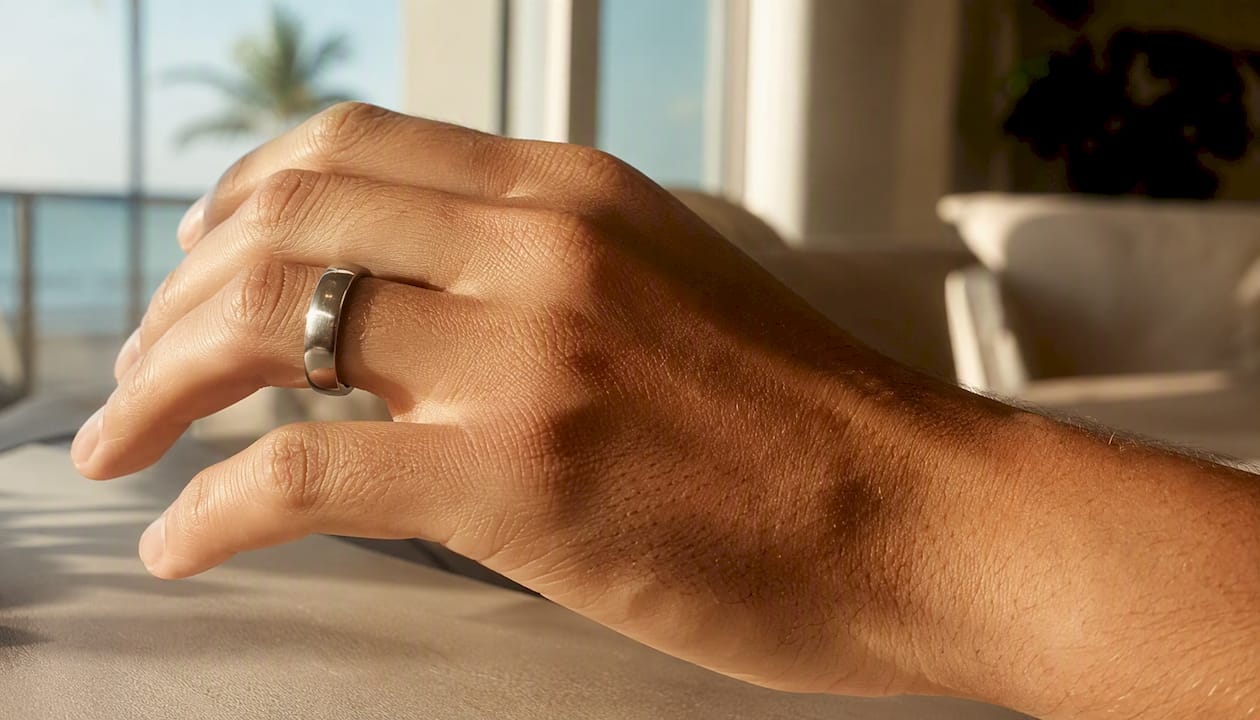
But “most people” isn’t everyone. If you have a confirmed, severe nickel allergy, or you’re shopping for a fresh piercing, or you’re choosing implant jewelry, titanium is the safer path. Commercially pure titanium contains no nickel, and its natural oxide layer is considered one of the most biocompatible surfaces available in jewelry, which is exactly why it’s the standard material for surgical implants. Fresh piercings in particular need a metal that won’t provoke irritation while skin is healing, and titanium consistently outperforms steel in that window.
Pro Tip: Ask sellers directly whether their “hypoallergenic” claim means nickel-free or simply “low nickel release.” Those are different promises. If you’ve had a documented reaction before, don’t rely on the label alone. Confirm the specific grade, and if in doubt, start with a titanium piece rather than testing steel again. Our guide to hypoallergenic jewelry brands for sensitive skin breaks down which brands are actually transparent about this.
Color And Plating: PVD, Anodizing, And What Lasts
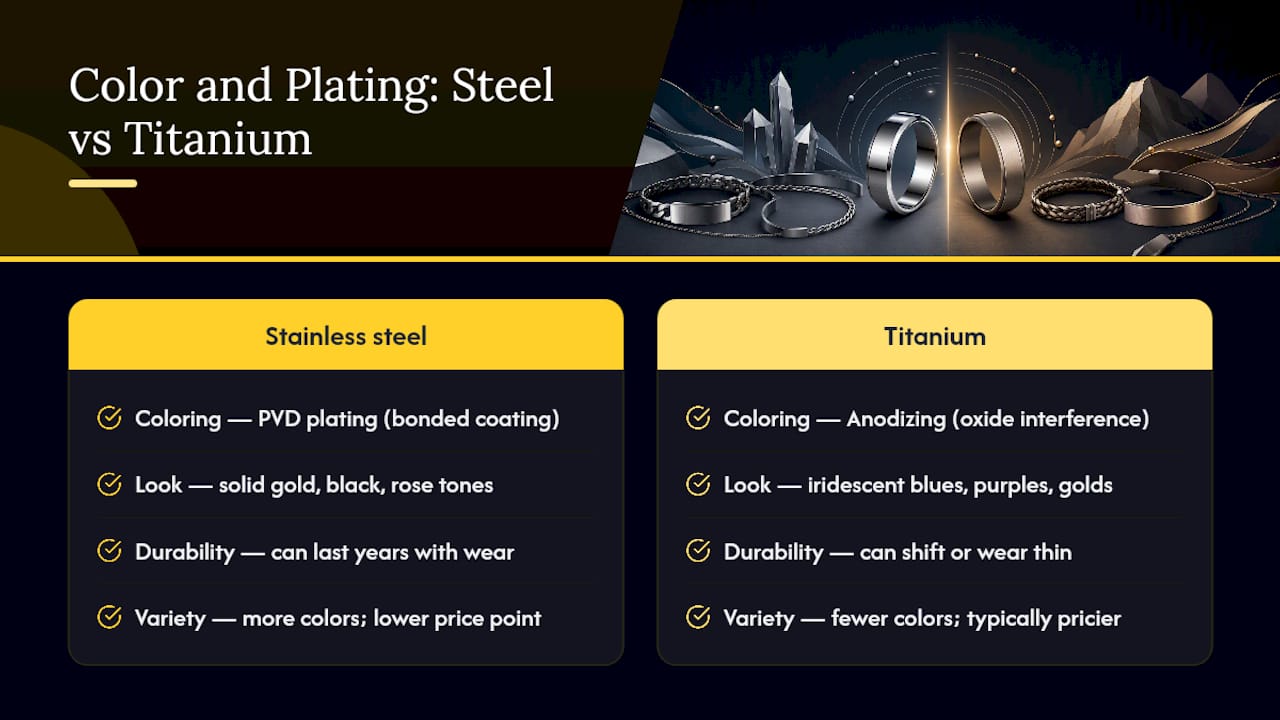
Stainless steel and titanium create color in completely different ways, and understanding that difference will save you from disappointment down the road.
316L stainless steel takes PVD plating well, a process that bonds a thin, hard coating of gold, black, or rose-toned metal onto the surface. Done properly, PVD plating on quality steel can last years of regular wear, and it’s a major reason stainless steel dominates affordable fashion jewelry lines. Jiman Jewelry’s comparison notes that steel’s compatibility with PVD gives it far more color variety at a lower price point than titanium typically offers.
Titanium gets its color through anodizing, a process that changes the thickness of its natural oxide layer to reflect different wavelengths of light rather than adding any material on top. The resulting colors, often blues, purples, and golds, have a distinctive iridescent quality you won’t see on plated steel. Because the color comes from the oxide layer itself and not a coating, it can shift or wear thin on areas with constant friction, like the inside of a ring band.
If you want a piece to look identical five years from now regardless of daily wear, PVD-plated stainless steel is the more predictable choice for that specific goal. If you want a unique, one-of-a-kind color effect and don’t mind some natural wear pattern developing, anodized titanium delivers something steel simply can’t replicate.
What You’ll Actually Pay, And When It’s Worth It
Expect to pay noticeably more for titanium jewelry than for comparable stainless steel pieces, and that gap gets wider once you’re comparing Grade 5 titanium against standard 316L. DAPU Metal’s cost analysis attributes the premium to both raw material costs and the specialized machining titanium requires, since its hardness makes it far more difficult and slower to cut, weld, and finish than steel.
The premium is worth paying when you have a confirmed nickel allergy, when you want the lightest possible daily wear piece, or when you’re buying jewelry for a fresh piercing or medical-adjacent use. In those cases, titanium isn’t a luxury upgrade, it’s solving a specific problem steel can’t solve as reliably.
Stainless steel delivers better value in nearly every other scenario, especially plated fashion collections where you want variety, brightness, and a lower per-piece cost. A $60 PVD-plated steel ring and a $300 titanium ring can look similarly polished on day one; the titanium piece earns its price through weight and biocompatibility, not through looking shinier.
Watch for a specific red flag here: unusually low prices attached to claimed “Grade 5” or “implant grade” titanium. Genuine Grade 5 titanium is expensive to machine, and a suspiciously cheap listing using that language is very likely mislabeled stainless steel or a lower titanium grade sold under a premium name.
How To Choose: A Buying Checklist That Actually Protects You
Run through this before you check out on any listing:
- Confirm the exact grade name. Look for “316L” or “surgical grade 316L” for steel, and “Grade 2” or “Grade 5 (Ti-6Al-4V)” for titanium. Vague terms like “titanium steel” or “premium alloy” with no number attached deserve skepticism.
- Check the plating or finish type. PVD plating should be named specifically; anodized titanium should say so rather than just “colored titanium.”
- Read the resizing and return policy. Titanium rings are difficult to resize because of the metal’s hardness and tendency to work-harden under stress, and even stainless steel resizing is limited compared to gold or silver. Know this before you guess on a ring size.
- Look for detailed photos, including the inside of the band and any edges, not just a polished hero shot.
- Search for real customer reviews or photos, which tend to reveal tarnishing, plating wear, or fit issues faster than product descriptions do.
Trust signals worth looking for: explicit grade names, references to implant or lab testing standards, a clear resizing or repair policy, and genuine customer photos. Red flags include marketing phrases with no grade attached, prices far below what a claimed grade should cost, and sellers who dodge direct questions about composition.
Pro Tip: If you’re buying a ring you might want resized later (say, for weight changes or gifting uncertainty), lean toward stainless steel rather than titanium. Titanium’s hardness makes professional resizing expensive and sometimes impossible, while steel rings have more repair options available. For ring-specific sizing guidance, our ring alternatives and sizing guide covers this in more depth.
Keeping Your Jewelry Looking New
Care for both metals starts the same way: mild soap, warm water, and a soft brush for any detail work around settings or textured surfaces. Avoid harsh abrasives, ultrasonic cleaners with aggressive settings, and anything acidic, especially on anodized titanium, since scrubbing too hard can wear down the oxide layer that creates its color.
PVD-plated stainless steel needs slightly more caution than solid steel. Avoid abrasive cloths or polishing compounds on plated surfaces, since those can wear through the coating faster than normal handling would. A soft microfiber cloth after wear removes oils and buildup without stressing the finish.
Store pieces separately rather than piled together in a drawer, since metal-on-metal contact is one of the most common causes of surface scratches over time. Solid stainless steel can go to a jeweler periodically for a full re-polish if it picks up fine scratches. Plated pieces and anodized titanium generally can’t be restored the same way, so protecting the finish day-to-day matters more than trying to fix it later.
How Wynwood Blvd Thinks About Metal Choice
We build most of our watches and jewelry around premium 316L stainless steel, and that’s a deliberate choice rooted in what our pieces actually need to do. Our designs draw on Miami, Key West, and the Florida Everglades, places defined by salt air, humidity, and constant exposure to water. Stainless steel’s combination of water resistance, polishability, and compatibility with vivid finishes fits that brief better than almost any other material at an accessible price point.
The mirror polish and color depth we use across collections like our Everglades Green and Sunset Orange watch lines depend on 316L’s ability to take a bright finish and hold plated color without the wear-pattern unpredictability anodized titanium can show on high-contact surfaces. That’s not a knock on titanium, it’s simply the right tool for pieces meant to look vivid and polished for years of coastal wear.
If you’re someone who wants a watch or piece of jewelry that reads as premium, handles daily water exposure without babying, and comes in bold, story-driven color options, our stainless steel construction is built exactly for that. If you have a confirmed nickel allergy, we’d point you toward titanium pieces specifically, since that’s a case where the material itself, not the brand, should drive the decision.
Shop Wynwood Blvd’s Premium Stainless-Steel Collection
If everything above points you toward stainless steel, that’s exactly where Wynwood Blvd focuses. Every watch and jewelry piece we make uses premium 316L construction, finished with the kind of mirror polish and PVD plating quality that holds up against saltwater, pool chlorine, and daily wear without fading fast.
Our designs pull directly from real coastal places, so a piece isn’t just water-resistant hardware, it carries the color and story of Wynwood, Miami Beach, or the Everglades on your wrist. The Atlantic Blue Automatic Watch and Everglades Green Automatic Watch both show off that finish quality directly. If rings or necklaces are more your speed, browse our rings collection or necklaces collection for pieces built on the same 316L standard.
If you’re sourcing branded watches or jewelry for a hotel, restaurant, real estate brand, or corporate gift program, we also handle custom logo engraving, dial customization, and bulk ordering. Browse the full watch collection to see current designs, or reach out to start a custom B2B order.
Sources
- AISI 316L (S31603) Stainless Steel vs Grade 2 Titanium — MakeItFrom
- Titanium vs stainless steel jewelry — SageStone
- 316L vs Titanium: Differences, Strength, Corrosion & Cost — Kongfang Metal
- Stainless Steel vs Titanium Jewelry: Pros, Cons & Price - Jiman Jewelry