1.5x Bail Rule: Fit Pendants and Charms to Your Chain
A pendant is a standalone focal piece designed to hang alone on its own chain. A charm is smaller, meant to be collected, swapped, or grouped with others on a bracelet or chain. The line blurs with bail size: a charm with a wide enough loop can wear like a pendant. A locket is really just a pendant that opens. The sections below cover size, attachment, materials, and how to shop for each.
TL;DR:
- Pendants are designed to be worn alone as statement pieces, while charms are smaller, intended for collection and layering on bracelets or chains.
- Material choices like stainless steel, silver, gold plated, and solid gold influence durability, wear, and maintenance needs over time.
- The attachment method, specifically bail size, is crucial to ensure compatibility with your chain’s thickness to prevent slipping or spinning.
- Buying a pendant online requires checking the bail’s inner diameter against your chain size, and for everyday wear, stainless steel is the most practical option.
- Charms can function as pendants if they have a wide enough bail, making them versatile for solo wear or layered styling.
Table of Contents
- Pendant vs Charm: What Actually Sets Them Apart
- What Is a Pendant? Definition, Materials, and When It Makes Sense
- What Is a Charm? Definition, Attachment Styles, and Everyday Uses
- Pendant vs Charm: Side-by-Side Comparison
- How to Choose Between a Pendant and a Charm
- Styling Rules: Layering Pendants and Charms Without the Tangle
- Real Examples: How Wynwoodblvd Approaches Pendant and Charm Design
- An Editorial Take on What People Actually Wear
- Shop the Palm Tree Collection
- Sources
- FAQ
Pendant vs Charm: What Actually Sets Them Apart
The short version: pendants solo, charms team up. A pendant is the decorative element that hangs from a chain. That distinction matters because a lot of shoppers use “necklace” and “pendant” as if they’re the same thing, and they’re not. The necklace is the whole piece. The pendant is just the part that dangles.
Charms work differently by design. Industry guides describe pendants as larger, standalone statement pieces, while charms stay smaller and are built to be combined, swapped, or collected over time. You buy one pendant to wear for years. You buy charms in twos and threes, adding to a bracelet or chain as your taste or your life changes.
What Is a Pendant? Definition, Materials, and When It Makes Sense
A pendant is the piece that hangs from a chain and does the visual work of the whole necklace. It’s not the chain itself, and it’s not the clasp. It’s the object your eye lands on first.
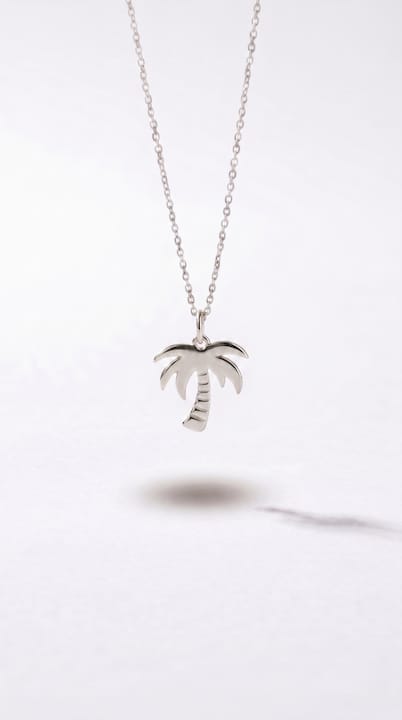
Pendants read as statement jewelry because of scale. A palm tree silhouette, a coin disc, a geometric bar. These sit in the center of the chest and are meant to be noticed, which is why most pendant necklaces are designed around a single hero piece rather than a cluster.
Material choice changes how a pendant behaves over years, not just how it looks on day one:
- Stainless steel resists scratches and tarnish, making it a solid pick for daily wear near water, sweat, or sunscreen.
- Sterling silver looks bright and refined but needs occasional polishing to prevent tarnish.
- Gold plated metals deliver the gold look at a lower price point, with a finish that wears down faster under daily friction.
- Solid gold costs more upfront but holds its color and value indefinitely.
One special case worth knowing: a locket is a specific type of pendant. Per the Collins Dictionary, a locket has a hinged or twist-open compartment built to store a photo or small keepsake, unlike a solid pendant that has no interior space at all.
What Is a Charm? Definition, Attachment Styles, and Everyday Uses
A charm is a small decorative piece designed to attach, detach, and travel between different pieces of jewelry. It’s not meant to carry a necklace on its own. It’s meant to join a group.
That group mentality is the whole point of a charm. You add one for a trip, another for a birthday, a third for an anniversary. Over time the bracelet or chain becomes a small, wearable timeline.
How a charm attaches determines where it can live:
- Split rings are the most secure option and standard on traditional charm bracelets.
- Lobster clasps let you swap a charm quickly between a bracelet and a chain.
- Jump rings are simple loops soldered or opened to link a charm to any base piece.
Charms aren’t limited to bracelets. Bag charms clip onto purse zippers or straps. Zipper pulls dress up a jacket. Charm necklaces string several small charms along one chain for a layered, collected look rather than a single-focus one.
Here’s where it gets interesting: a charm can absolutely function as a pendant, provided the bail or jump ring is wide enough to slide smoothly over a chain and the charm has enough visual weight to stand alone. A charm pendant is the industry’s own term for exactly this hybrid: a charm-sized piece sold to be worn solo on its own chain.
Pendant vs Charm: Side-by-Side Comparison
Once you understand the basic definitions, the buying decision usually comes down to five practical factors: how prominent you want the piece, how it attaches, what it’s made of, how you’ll care for it, and whether you’re looking at a locket.
| Factor | Pendant | Charm |
|---|---|---|
| Visual role | Solo focal point | Supporting or collectible piece |
| Typical use | Statement necklace, daily signature | Bracelet, layered chain, bag accessory |
| Attachment | Fixed or sliding bail | Split ring, lobster clasp, jump ring |
| Materials favored | Stainless steel, silver, gold, gold plated | Same range, often mixed with enamel or paint |
| Care needs | Polish plated finishes occasionally | Protect painted or enameled surfaces from friction |
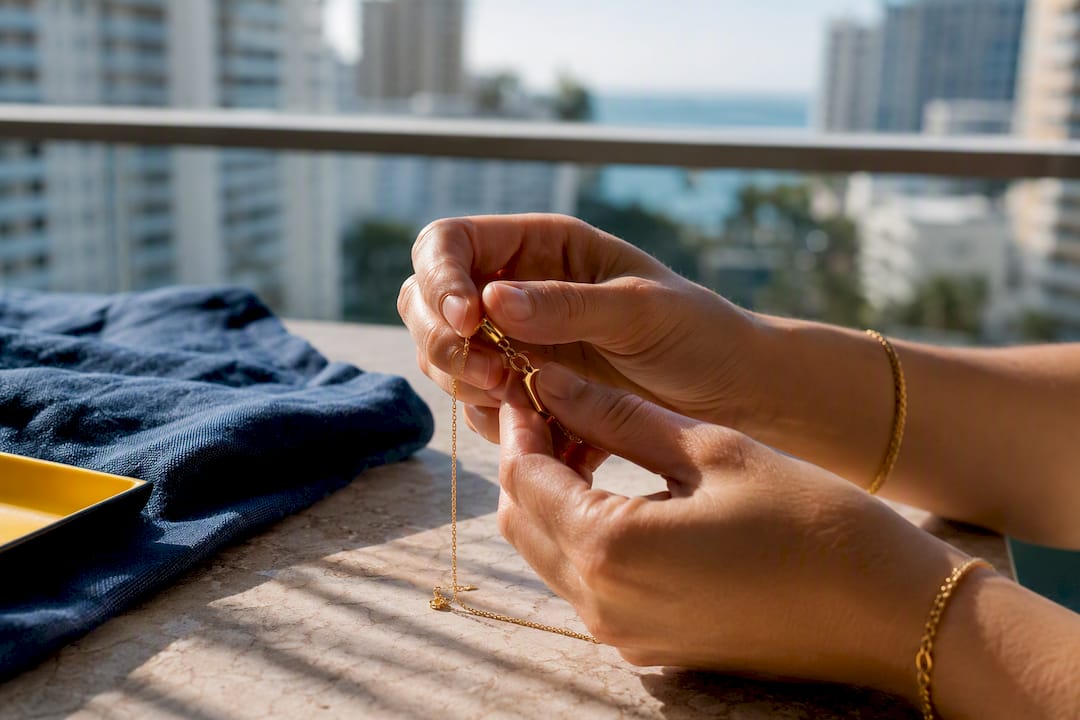
Attachment compatibility trips up more buyers than material choice does. A bail that’s too tight won’t slide over a thicker chain, and a bail that’s too loose will let the pendant flop and spin. Wynwoodblvd’s own guidance on chain types and bail sizing recommends the bail’s inner width run at least 1.5 times the chain’s thickness, so the piece hangs centered instead of sliding sideways.
Pro Tip: Before buying a pendant online, check the bail’s inner diameter in the product specs and compare it against the chain you already own. A mismatch is the single most common reason a new pendant ends up sitting in a drawer.
Material durability plays out differently depending on how often you wear the piece. Stainless steel handles daily wear without scratching or tarnishing, which makes it the more practical everyday choice. Plated metals look great for occasional wear or special occasions but wear thinner with constant friction against skin and fabric.
Care differs by finish, not just by category. A polished stainless steel pendant needs almost nothing beyond an occasional wipe. A painted or enameled charm needs more care: keep it away from harsh chemicals, remove it before swimming, and store it separately so it doesn’t scratch against harder metal pieces.
And the locket, again, deserves its own mention. A locket opens to hold something personal, which makes it functionally different from every other pendant on this list, even though it hangs and wears exactly the same way.
Quick decision checklist:
- Want one piece to wear every day and rarely think about? Choose a pendant.
- Want to build a collection over months or years? Choose charms.
- Buying online? Confirm bail width against your chain thickness before checkout.
- Want sentimental storage, not just decoration? Look specifically for a locket.
How to Choose Between a Pendant and a Charm
Buying the wrong format is an easy mistake to avoid once you know what to check. Work through these five steps before you add anything to your cart.
- Measure the bail or jump ring. Compare its inner width to your existing chain. If you’re shopping in person, physically slide the chain through before buying.
- Decide how you’ll actually wear it. Daily wear favors a pendant in a durable metal. Occasion wear or gift giving leaves more room for delicate finishes and collectible charms.
- Match material to your budget and timeline. Stainless steel costs less and needs almost no upkeep. Vermeil sits in the middle. Solid gold costs the most but never needs replating.
- Check the return and repair policy. Bail sizing issues and clasp failures are common enough that a fair return window matters more than most shoppers realize.
- Think about personalization. A locket for a photo, an engraved pendant for a name or date, or a charm series you plan to add to over time all change which format makes sense.
Styling Rules: Layering Pendants and Charms Without the Tangle
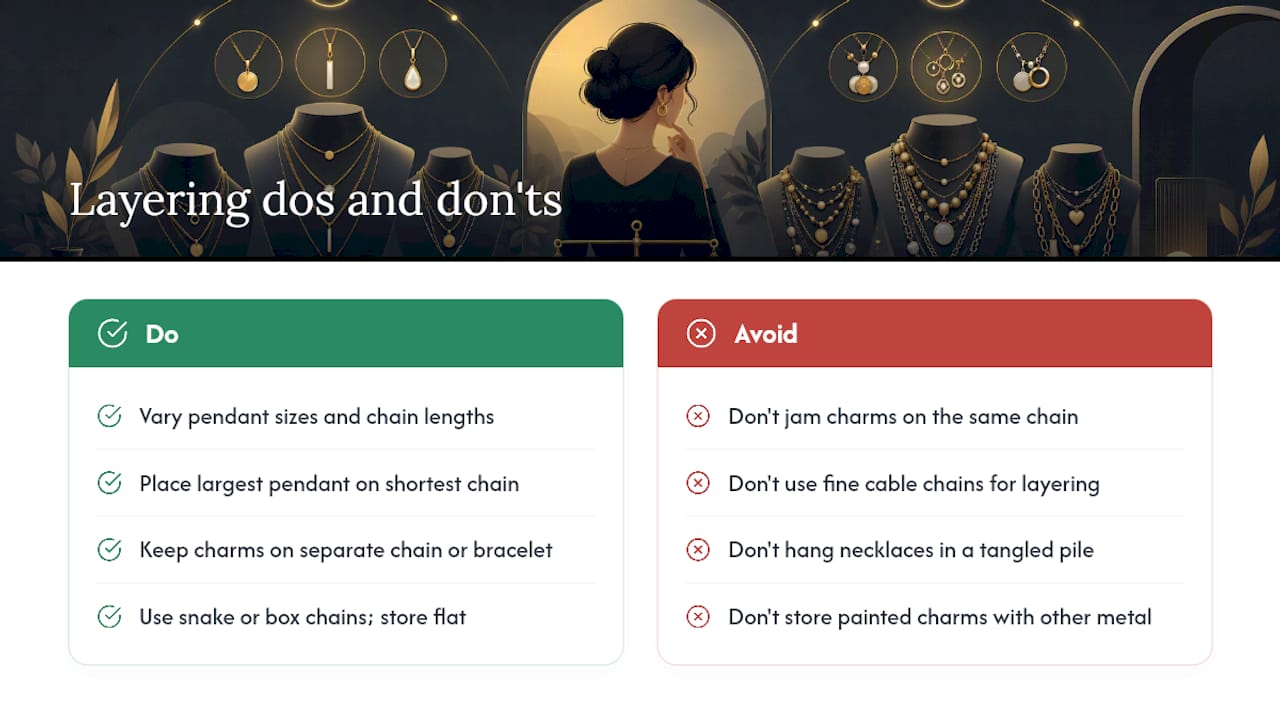
Layering works best when sizes and chain lengths vary on purpose. Put your largest pendant on the shortest chain so it sits as the visual anchor, then add one or two shorter pieces on longer chains behind it.
Keep charms and pendants in separate lanes when you can. A charm cluster reads best on its own chain or bracelet rather than jammed onto the same chain as a large pendant, which crowds the focal point instead of supporting it.
Chain type affects tangling more than most people expect. Snake chains and box chains resist twisting better than fine cable chains when layered. Lay necklaces flat in a jewelry tray instead of hanging them in a tangled pile.
Pro Tip: Store painted or enameled charms in a soft pouch, separate from other metal pieces. Direct contact with harder jewelry is the most common cause of chipped paint.
Real Examples: How Wynwoodblvd Approaches Pendant and Charm Design
Some Palm Tree pieces illustrate this pendant versus charm distinction, using scale and finish to decide which role each piece plays.
- The Palm Tree Charm, Silver Classic, a stainless steel minimal pendant, keeps a compact, understated silhouette suited to a thin box or cable chain worn daily.
- The Palm Tree Charm, Gold Classic, a stainless steel Miami inspired pendant, uses a warmer gold tone and slightly bolder profile for a statement piece that still resists tarnish.
- The Palm Tree Charm, Silver Signature Painted, a stainless steel Miami statement pendant, adds hand-painted color detail, which shifts it toward occasional wear where the enamel finish stays protected from constant friction.
Stainless steel and painted finishes get chosen for coastal-inspired pieces specifically because salt air, sunscreen, and pool water punish plated metals fast. A few proof points worth knowing: Some jewelry designs are inspired by real Miami or coastal locations, with options that reflect direct-to-consumer and custom branded pieces for business clients.
An Editorial Take on What People Actually Wear
Pendants tend to become daily signatures. People pick one, wear it for years, and rarely take it off. Charms tend to become memory objects. Nobody wears a full charm bracelet every single day, but almost everybody keeps adding to one over time.
Neither instinct is wrong. The mistake is buying a charm expecting it to carry a look alone, or buying a bold pendant expecting to layer it into a rotating collection. Match the format to how you actually get dressed, not to which one looks better in a product photo.
— Mathias
Shop the Palm Tree Collection
Wynwoodblvd designs its jewelry around real coastal locations instead of generic tropical motifs, which is the clearest advantage if you want a piece with an actual story behind it rather than a stock palm tree charm.
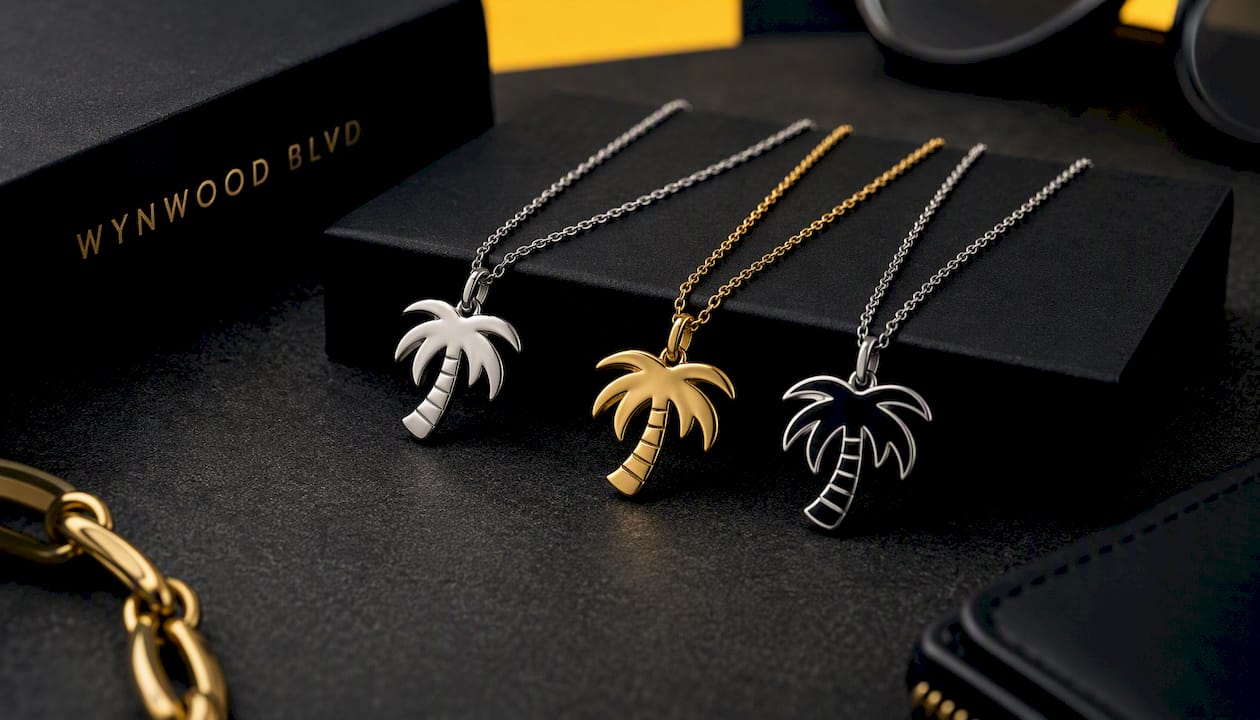
If you want something minimal for daily wear, the Palm Tree Charm, Silver Classic delivers a low-profile stainless steel pendant that holds up against sweat and salt water. Want more warmth and presence, without sacrificing durability? The Palm Tree Charm, Gold Classic brings a Miami-inspired gold tone in the same scratch-resistant steel. For a statement piece with hand-painted color, look at the Palm Tree Charm, Silver Signature Painted. Browse the full Palm Tree Charms lineup or the broader charm collection to compare finishes side by side.
Running a hotel, agency, or retail brand and want branded pieces for staff or clients? Wynwoodblvd’s Corporate Custom Watches program extends to custom jewelry orders with logo engraving and packaging options for bulk gifting. Reach out through that page to start a custom order.
Sources
- Collins Dictionary — locket
- Pendants for Jewellery Making: Your Ultimate Guide | JewelryBuyDirect
- Pendant jewellery: types, materials and buying tips
- Locket — Wikipedia
FAQ
Is a Pendant Always a Necklace?
No. A pendant is just the hanging decorative piece; a necklace is the complete item, meaning the chain plus whatever pendant hangs from it. Some pendants are sold separately so you can pair them with a chain you already own.
What Is a Necklace Charm Called?
A small decorative piece on a necklace is simply called a charm, and when it’s sized and designed to be worn alone on a chain, retailers often label it a charm pendant. The term describes a hybrid: charm scale, pendant function.
What Is the Point of a Pendant?
A pendant serves as the focal point of a necklace, giving the eye a single place to land rather than spreading attention across several small pieces. It’s typically larger and more prominent than a charm, which is built for combining and collecting rather than standing alone.
Can a Pendant Go on Any Chain?
Not quite. The bail’s inner width needs to comfortably clear the chain’s thickness, ideally around 1.5 times the chain’s diameter, so the pendant slides and hangs centered instead of gripping or spinning. Check Wynwoodblvd’s chain and bail sizing guidance before pairing a new pendant with an existing chain.